What we do
Automated inspection for humanoids
A humanoid is only certified once, at design. We are the third party who inspects each one of them in depth for as long as it runs: on the operator’s site, against a calibrated reference.
Every machine that works near people is checked by someone who did not build it. A car passes a brake test on an independent lane. A forklift gets a yearly check, signed by an inspector. A humanoid is checked only by the company that sold it.
A TÜV inspector will not fix that. They test what a person can reach: the emergency stop, the outside of the machine, the paperwork. The wear sits deeper, in the thirty-odd joints under the shell, each a motor, a gearbox and a bearing. So we build the check as a machine: a test station on the operator’s site, one 15-minute pass per robot, no human in the loop.
01/05
The problem
The problem
Today every humanoid works behind a fence. The industry wants it gone by 2027. Without the fence, a humanoid has to be checked like any machine that works near people. It cannot be, for two reasons.
First, the wear is invisible to the operator. On a robot arm, wear shows in the operator’s parts: a weld lands slightly off, a hole drills slightly oval. Quality control catches it weeks before a failure. On a humanoid, the AI sees every small mechanical error and corrects it in real time, so the wear never reaches the parts. The signal still exists, but only as correction data on the maker’s servers. The operator loses the early warning it has on every other machine.
Second, nobody but the maker knows what state a humanoid is in. Thousands of parts sit under the shell, and none of them show. The AI that drives them can have a bad run for no mechanical reason at all.
So when a humanoid drops a crate, every cause looks alike from outside. A worn grip. An actuator out of adjustment. A skipped service. Or nothing broken at all. The evidence is the same: a crate on the floor.
Nobody will ever prove why the AI let go. But whether the robot was within spec that month can be measured, from outside. Nobody does it.
Three questions arrive the same week.
The works council
Who verified this machine was still safe next to our people?
Nobody outside the company that sold it.
The insurer
What was its measured condition before the incident?
There is none. Only telemetry, and the software changed twice since, so nobody can say if the numbers show wear or new code.
The court
Can anyone independent attest to its state at any point in its life?
It was never measured from outside.
02/05
Why nobody else can do it
Why nobody else can do it
Three actors could try to fill the gap. Each one is structurally blocked.
The operator’s own staff legally suffices for a forklift. For a humanoid it fails twice: no employee can see 0.1 mm of joint drift or a force sensor reading 8% high on a walk-around, and before an insurer or a court, an employee’s signature is a self-check.
The maker is best equipped to watch its machines: internal sensors, data from the whole fleet. But it measures the robot with the robot’s own sensors, its baseline resets at every update, and it would set the threshold at which its own product is declared unfit, with an economic interest to delay it. Judge and party.
The TIC giants (TÜV, SGS, DEKRA) inspect machines in service at scale, but their format is a person with a checklist. A humanoid needs a calibrated station, a protocol per model, and a history that starts on day one. None of that is in their catalogue. Their play in a new market is to buy the specialist once it is proven: SGS bought CertX, the Swiss AI-safety certifier, in December 2024. Until this one is proven, they will not build for it. That is our window.
Independence is codified: ISO 17020, the standard behind vehicle and elevator inspection bodies, requires the inspecting body to be independent from the design, manufacture, supply and maintenance of what it inspects. That box is empty. We are the company that fills it.
Detection of wear hidden by self-correction
External calibrated reference
Before/after report on every update
Automated checks at fleet scale
Signature that stands before third parties
See more of the comparison: all ten building blocks, the reasoning behind every verdict, and the two assumptions it rests onSee less
Documented periodic check (existing legal duty)
Demanded by
Labour inspectorate
- Operator staffYesInternal competent person legally sufficient, as for a forklift (BetrSichV §14, R4323-24).
- Robot manufacturerPartialContinuous telemetry, but self-declared and kept by the maker.
- AIH GlobalYesWritten protocol, set cadence, third party who signs.
Detection of wear hidden by self-correction
Demanded by
Operator, insurer
- Operator staffNoAI corrects small errors in real time: nothing shows to the eye or logbook.
- Robot manufacturerYesBest equipped. Internal sensors, whole-fleet data. Limit: the baseline resets at every update, and the measuring sensors are the drifting ones.
- AIH GlobalYesLess finely than the maker. Periodic external measurement against continuous telemetry; in exchange, a physical reference that never moves.
External calibrated reference, traceable
Demanded by
Insurer, buyer, court: anyone who must trust the numbers without taking someone’s word
- Operator staffNoNo reference artifacts, no metrology.
- Robot manufacturerNoBy definition. Its sensors measure themselves; an instrument cannot verify itself.
- AIH GlobalYesThe core craft: certified artifacts, calibration rotation, published uncertainty budget.
Force accuracy (newtons, grip)
Demanded by
Works council, safety
- Operator staffNoNewtons cannot be seen; calibrated sensor required.
- Robot manufacturerPartialOnboard force-torque sensors drift, a documented failure mode.
- AIH GlobalYesHandle on force sensor and grip dynamometer, checked against reference weights.
Before/after report on every update
Demanded by
Operator, regulator
- Operator staffNoNo measured baseline, nothing to compare.
- Robot manufacturerPartialCannot tell “new software” from “worn mechanics”, and validates its own update.
- AIH GlobalYesSame handle, same targets, same protocol: the reference survives updates.
Automated, fast checks at fleet scale
Demanded by
Operator, and above all the maker: proven efficiency sells robots
- Operator staffNoWould have to develop the whole station, hardware and process.
- Robot manufacturerPartialCould build a bench, but own robots only, not multi-brand, still not independent.
- AIH GlobalYesSpecialized station: one pass in about 15 minutes, no human during the run, multi-model by design.
Safety functions re-tested in service (e-stop, stopping distance)
Demanded by
Labour inspectorate, works council
- Operator staffPartialCan trigger the e-stop, cannot measure stopping distance against specs.
- Robot manufacturerPartialFull factory burn-in on new robots; nothing on the worn unit at 4,000 h on site.
- AIH GlobalYesYearly visit: e-stop triggered, stopping distance measured against declared specs.
Tamper-proof record per serial number
Demanded by
Insurer, used-market buyer, financier, court
- Operator staffPartialHand-kept logbook possible, but self-declared, no measurement behind it.
- Robot manufacturerPartialHolds the only record, in its cloud, and can rewrite it.
- AIH GlobalYesThird-party record, append-only, signed, timestamped, access decided by the operator.
Signature that stands before third parties
Demanded by
Insurer, court, works council
- Operator staffPartialAccepted by the labour inspectorate (forklift precedent); weak before insurer and court: an employee of the exposed party.
- Robot manufacturerNoJudge and party: its signature on its own robots convinces neither insurer, court, nor buyer.
- AIH GlobalYesOne nuance. Contractual value from day one; official weight with ISO 17020 accreditation, which takes one to three years.
Scrap thresholds, written reference frame
Demanded by
Everyone (exists nowhere yet)
- Operator staffNoNo reference frame exists, no fleet data to write one.
- Robot manufacturerPartialWould set the threshold at which its own product is declared unfit, with an economic interest to delay it and cover itself after an accident.
- AIH GlobalPartialTo be built. Thresholds exist nowhere; the 90-day test and the first measured fleet create them, and that is the asset.
Row heads in full: Operator, trained staff, no complex hardware · Robot manufacturer · Us, AIH Global.
Two assumptions, checked
“Only a third-party signature counts” is true with one nuance. ISO 17020 recognizes in-house inspection bodies (type B), accreditable, inspecting only for their parent. But third-party inspection is reserved for type A bodies, whose staff may be neither manufacturer, owner, user, nor maintainer of what they inspect. For insurer, buyer and court, type A is what counts: our box.
“The operator cannot sign anything” would be false as stated. Periodic check by an internal competent person legally discharges the employer’s duty (forklift precedent: BetrSichV §14, TRBS, R4323-24). Hence “Partial” in its signature cell: its word holds for the labour inspectorate, weakens as soon as proof crosses an organizational boundary.
Sources: ISO/IEC 17020:2012 and IAF/ILAC A4 guide (types A, B, C); Directive 2009/104/EC art. 5 and national transpositions.
03/05
The product
The product
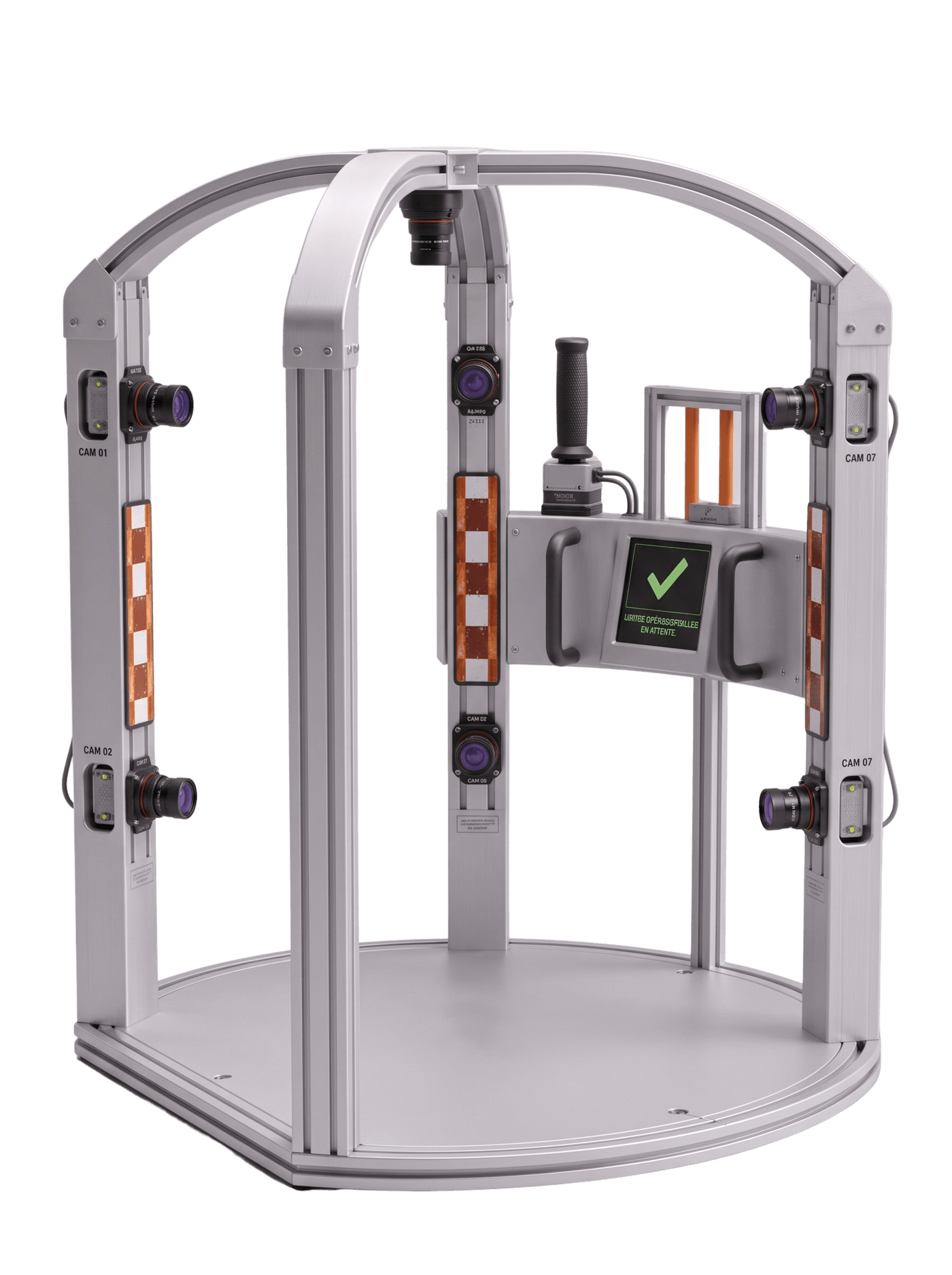
The test station
A fixed stand on the operator’s site. Each humanoid runs the same 15-minute scripted pass: reach a reference handle, press a calibrated force point, read test targets. Part of the pass runs with the AI correction switched off. Correction on, the humanoid hides its wear; correction off, the wear shows. No human in the loop.
The record
Every pass stored under the humanoid’s serial number: measurements, the exact software version that day, alerts, incidents. After every update, a before and after report. One life record per humanoid, kept by a third party, readable by the people the operator chooses.
The certificate
Once a year, someone like a TÜV-certified inspector comes on site for the manual checks the station cannot run, the emergency stop among them. Then reads our record and signs.
04/05
Why now
Why now
Trust is built with capital and pilots today. Mercedes piloted Apollo for a year in its plants, then bought a stake in Apptronik. Schaeffler took a minority stake in Agility and buys its robots. Renault holds shares in Wandercraft. BMW ran an eleven-month pilot with Figure.
It works for the first deployments, and the fence is part of why: the robot still works away from people, so the proof it needs is thin. Take the fence down and it is not. The next thousand operators will not buy shares in their robot supplier and will not run year-long pilots. They need a standard way to verify the machines. We build it.
On 20 January 2027, EU Machinery Regulation 2023/1230 applies. A safety function that self-evolves loses self-declaration and goes to a notified third party. A substantial change, physical or digital, makes whoever made it the manufacturer of a new machine. All of it fires at market placement. After day one, nothing: no method, no frequency, no third party.
Insurance is being written now, for businesses. The first humanoid policies exist, in China, covering fleets across production, sale, leasing and use. They price the robot flat, because no measure of its condition exists to price on: insurers state openly that they cannot rate this risk without a loss history. Whoever produces the first measured history sets the reference.
In-service inspection for humanoids is not standardized, not announced, not staffed. That gap is AIH Global.
05/05
Who
Who
AIH Global is built in Zurich, Switzerland.

Founder
Melvin Zerigue
Industrial engineer: metrology, quality certification, hardware prototyping, experience in manufacturing environments.
Co-founder
Not yet named
Engineering student at ETH Zurich, member of the ETH Robotics Club.